Introduction
You are ready to buy a portable power station, but the spec sheet looks like a math test.
“2000Wh Capacity?” “2000W Output?”
What is the difference, and why does it matter? If you ignore these two acronyms, you risk buying a unit that can’t even turn on your coffee maker or dies after just one hour.
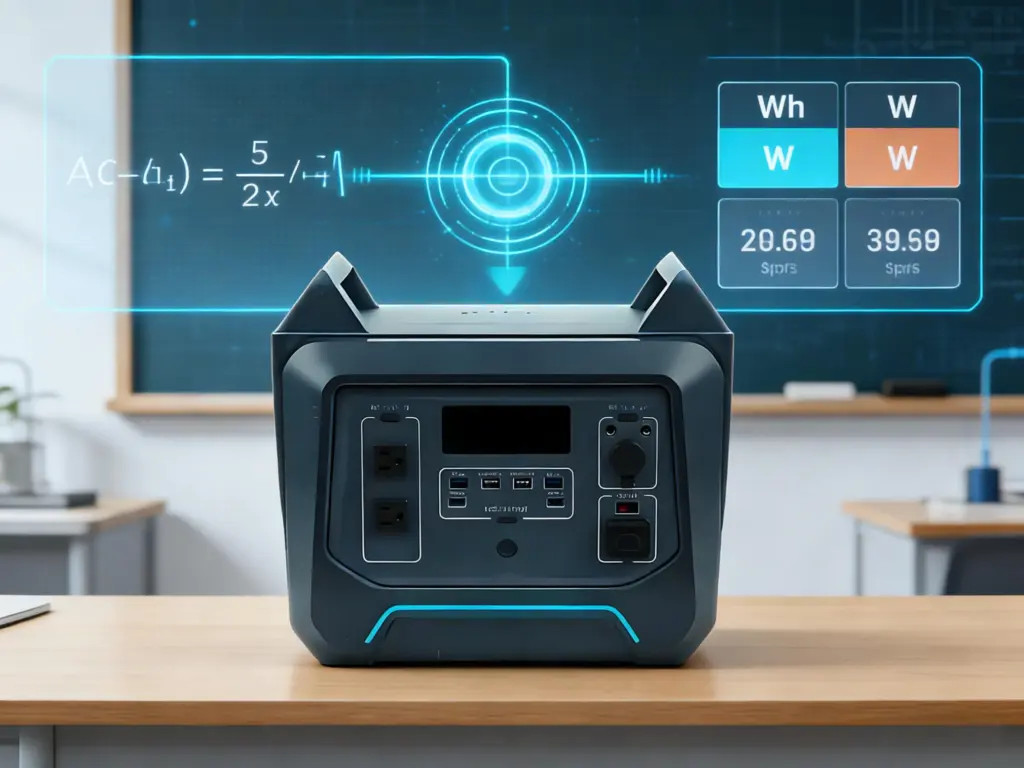
In this guide, we break down Wh (Watt-hours) vs. W (Watts) using a simple analogy. Plus, we give you the “Golden Formula” to calculate exactly how long your devices will run.
1. The Simple Analogy: The Bucket and The Hose
Forget the engineering jargon. Think of electricity like water.
- Wh (Watt-hours) = The Size of the Bucket
- This is the Capacity.
- It tells you “How much energy is stored.”A bigger Wh number means a bigger tank. It determines how long devices will run.
- W (Watts) = The Width of the Hose
- This is the Power Output.
- It tells you “How fast the energy can flow out.”A bigger W number means you can power “thirstier” appliances like microwaves or hair dryers.
【Common Mistakes】
- The Hose is too thin (Low Watts): Even if you have a massive bucket (High Wh), if your hose is a tiny straw, you can’t power a pressure washer. Similarly, a 500W power station cannot start a 1000W microwave. It will simply shut down.
- The Bucket is too small (Low Wh): If you have a giant firehose (High Watts) but a tiny bucket, you will drain the water in seconds.
2. The “Will It Last?” Calculator
You cannot just take the box rating (Wh) and divide it by your device’s watts. You must account for Conversion Efficiency (energy lost as heat during operation).
Use this formula to find the real runtime:
The Formula:
Capacity (Wh) × 0.85 (Efficiency) ÷ Device Wattage (W) = Runtime (Hours)
【Real World Example: Using the JD Power E2000 (2000Wh)】
- Charging a Smartphone (15W): $2000 \times 0.85 \div 15 \approx 113$ Hours (Over 100 full charges)
- Running a Car Fridge (50W): $2000 \times 0.85 \div 50 = 34$ Hours
- Powering a Microwave (1000W): $2000 \times 0.85 \div 1000 = 1.7$ Hours
Note: Most standard lithium batteries only offer 70-80% efficiency. JD Power’s advanced system offers a high efficiency of approx. 85%, giving you more power for your money.
3. Why JD Power? The “Honest Spec” Advantage
Not all “Watt-hours” are created equal. Some cheap brands label their products as “1000Wh,” but due to poor quality inverters and cheap battery cells, you might only get 600Wh of usable power. This is “spec inflation.”
JD Power uses cutting-edge Semi-Solid State Battery technology. This chemistry is not only safer but also provides stable voltage and high efficiency.
We don’t fake our numbers.
When you buy 2000Wh from JD Power, you get the professional-grade runtime you expect.
Conclusion
- Check the Watts (W) to see IF it can power your device (e.g., you need high Watts for heaters/tools).
- Check the Watt-hours (Wh) to see HOW LONG it will run.
If you want a machine that does both—handling heavy-duty tools AND lasting for days—the JD Power E2000 combines high output with massive capacity and superior efficiency. Don’t settle for a small bucket or a thin hose.
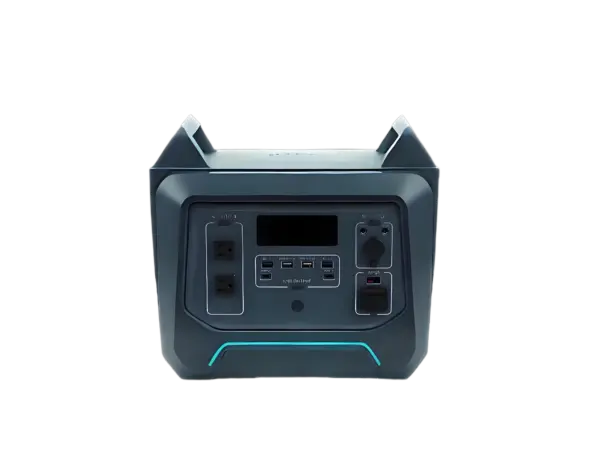
Industry’s first portable power supply with Semi-Solid State battery 2044Wh high capacity E2000
Revolution Unleashed – Semi-Solid State Energy for Extreme Adventures
Experience the future with groundbreaking Semi-Solid State battery technology:
✓ Zero Fire Risk: No liquid electrolyte = 100% explosion-proof (UN38.3 certified)
✓ -20°C Arctic Proof: Outperforms lithium-ion in freezing conditions
✓ 5X Faster Charge: 0-80% in just 1.17 hours(industry record)
✓ 20-Year Lifespan: 2,000+ cycles with <10% degradation